
Applications of Hardness Test Blocks in Aerospace Industry
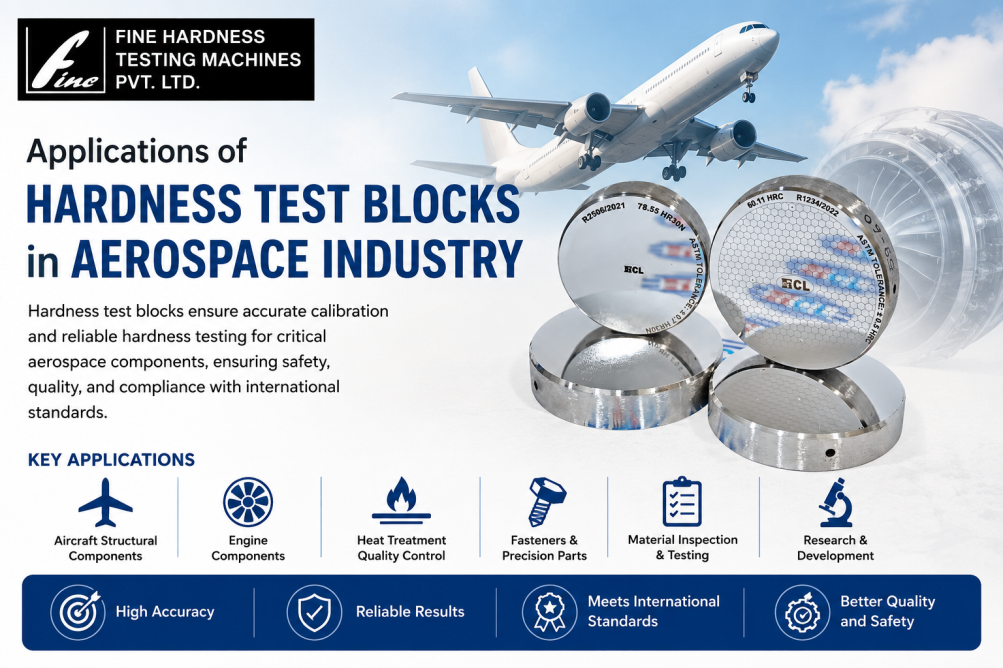
The Aerospace Industry requires the highest level of accuracy, strength, safety and reliability. Aircraft components are subjected to extreme conditions of pressure, vibration, temperature and constant mechanical stresses. All components have to be carefully tested for safety and performance.
One of the most important tools used in material testing in the aerospace industry is the hardness test block. These calibration blocks are employed to give accurate and reliable hardness testing machine readings.
Let's look at some of the uses of hardness test blocks in the aerospace industry and understand the importance of them in maintaining your quality and compliance requirements.
What are Hardness Test Blocks?
Hardness test blocks are certified reference blocks with a known hardness value used to verify and calibrate hardness testing machines.
They help maintain accuracy in hardness testing systems such as:
-
✔️ Rockwell hardness testers
✔️ Brinell hardness testers
✔️ Vickers hardness testers
These blocks ensure consistent and repeatable test results in industrial laboratories.
Importance of Hardness Testing in Aerospace Industry
The mechanical properties of the material used in the aerospace industry need to be extremely high, to ensure that an aircraft is safe and durable.
Hardness testing is useful in helping manufacturers:
- Verify material strength
- Ensure wear resistance
- Detect material defects
- Maintain structural integrity
- Pass aerospace quality requirements
Aviation stability and performance are affected by any material variations, no matter how slight.
Why Hardness Test Blocks are Critical in Aerospace Testing
Hardness testing machines must be calibrated regularly for accurate measurements.
Hardness test blocks help:
-
✔️ Maintain testing accuracy
✔️ Verify machine performance
✔️ Ensure compliance with ASTM and ISO standards
✔️ Reduce testing errors
✔️ Improve quality control processes
Key Applications of Hardness Test Blocks in Aerospace Industry
1. Aircraft Structural Component Testing
High strength metals and alloys like aluminum, titanium and stainless steel are used for the construction of aircraft structures.
Hardness test blocks help ensure accurate testing of:
- Aircraft frames
- Wings
- Landing gear components
- Structural supports
Accurate hardness measurement ensures these components can withstand operational stress.
2. Aerospace Alloy Verification
Advanced aerospace alloys require precise hardness testing to maintain quality standards.
Hardness test blocks are used to calibrate testing equipment for:
-
✔️ Titanium alloys
✔️ Nickel-based alloys
✔️ Heat-treated aerospace materials
3. Engine Component Testing
Aircraft engines operate under extremely high temperatures and pressure conditions.
Hardness testing is essential for components such as:
- Turbine blades
- Shafts
- Gears
- Bearings
Test blocks ensure testing machines deliver precise readings for critical engine parts.
4. Heat Treatment Quality Control
Heat treatment processes improve material hardness and durability.
Hardness test blocks help verify:
- Proper heat treatment results
- Material consistency
- Surface hardness accuracy
This is important for maintaining aerospace manufacturing standards.
5. Aerospace Research & Development Laboratories
Research laboratories use hardness testing during material development and innovation.
Hardness test blocks help scientists and engineers achieve accurate results during:
- New material testing
- Prototype development
- Fatigue analysis
6. Fasteners and Precision Components Testing
Aerospace fasteners and precision parts must meet strict hardness requirements.
These include:
- Bolts
- Rivets
- Connectors
- Precision machined parts
Proper hardness testing ensures reliability and long-term performance.
Benefits of Using Hardness Test Blocks in Aerospace Industry
-
✔️ High Accuracy:
Ensures precise calibration and reliable testing results.
✔️ Compliance with International Standards: Supports ASTM, ISO, and aerospace certification requirements.
✔️ Improved Safety Accurate testing reduces risk of material failure.
✔️ Consistent Quality Control: Ensures uniform testing across production processes.
✔️ Reduced Testing Errors: Improves reliability of material evaluation.
Best Practices for Using Hardness Test Blocks
To obtain correct results, industries are advised to practice the following:
Ensure that the block is certified to be used.
Properly store the blocks in clean environments.
-
✔️ Avoid scratches or surface damage
✔️Do regular calibration checks
✔️Replace worn blocks as needed
Common Challenges in Aerospace Hardness Testing
-
❌ Calibration Errors:
Improper calibration can lead to inaccurate results.
❌ Surface Damage: Scratched test blocks affect testing accuracy.
❌ Environmental Factors: Temperature and contamination can impact measurements.
Proper handling and maintenance help avoid these issues.
Latest Trends in Aerospace Material Testing
- Digital Hardness Testing Systems: Automated systems improve accuracy and efficiency.
- Smart Calibration Technologies: Advanced software tracks calibration performance.
- AI-Based Quality Control: Artificial intelligence helps detect testing irregularities.
- Industry 4.0 Integration: Connected systems provide real-time testing data.
Why Quality Matters in Aerospace Testing
Quality control is directly related to safety and operational reliability in aerospace manufacture.
High quality hardness test blocks help to ensure:
- Accurate calibration
- Reliable material testing
- Aerospace regulations Compliance
- Long-term equipment performance
Aircraft safety and performance rely on the precision testing.
Conclusion
The most stringent accuracy, strength, safety and reliability are required in the Aerospace Industry. Aircraft component parts are subjected to high-pressure, high vibration, high temperature and continuous mechanical forces. Safety and performance of all components must be carefully tested.
The hardness test block is one of the most crucial tools employed in aerospace material testing. Calibration block is employed to provide the accurate and reliable hardness testing machine reading.
We will discuss the applications of Hardness Test Block in the Aerospace Industry and why it is so vital to quality and compliance in the industry.
FAQ
They are used to calibrate hardness testing machines for accurate material testing.
It ensures material strength, durability, and safety of aircraft components.
Aircraft structures, engine parts, fasteners, and aerospace alloys.
Regular calibration is recommended according to industry standards and testing frequency.